Agencies that run influencer campaigns for many clients at once do it with one standard workflow and strict separation between clients: each brand gets its own space, its own approvers and its own report, while the team uses the same templates and steps for everyone. Consistency is what lets a small team handle a big client list.
Without that, every new client adds a new WhatsApp group, a new tracker and a new way of doing things, and the team spends more time remembering how each client likes it than running campaigns. Here's how to set up a workflow that scales.
One workflow, every client
Clients differ in brand, budget and taste. The steps of a campaign don't. Agree one workflow internally and use it for every brand:
Shortlist. Propose creators from your network; the client gives feedback and accepts.
Contract and confirm. Rates, usage rights and dates agreed with each creator.
Drafts. Creators submit; your project manager reviews first, then the approver (your client).
Posting. Creators post on the agreed date and share links.
Report. Weekly updates during the campaign, a final report after.
Payment. Creators paid on schedule once posts are verified.
What changes between clients is the content of each step, not the steps themselves. A new account manager can then pick up any client and know where things stand.
Keep clients completely separate
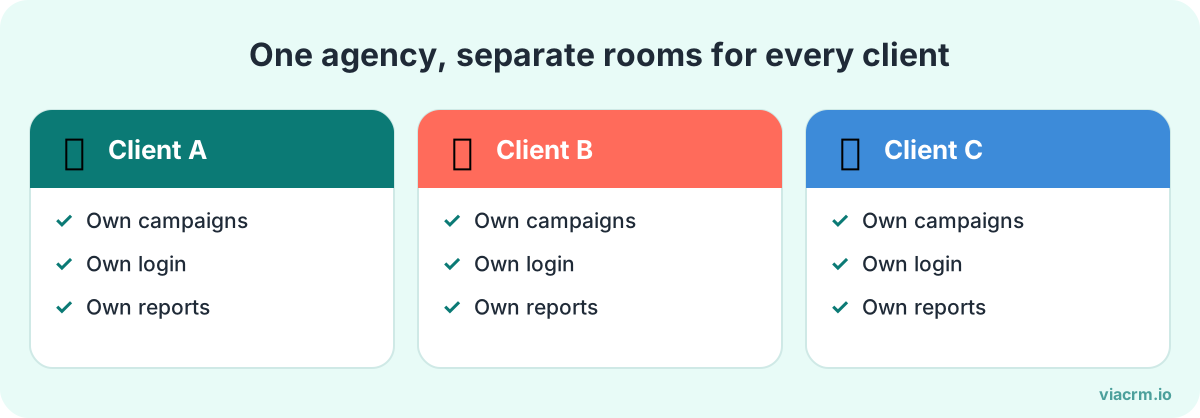
Clients never see each other's creators, prices or results.
Mixing clients is the mistake that does the most damage. A competitor's draft sent to the wrong brand, or one client seeing another's creator rates, can lose you both accounts.
Separate spaces per brand, not one giant tracker with a 'client' column.
Separate approvers per brand. Each client only ever sees their own drafts and results.
Separate chat threads, and never add creators to a group that includes another client's people.
Watch for conflicts. If a creator is working with two competing brands in the same month, flag it before the shortlist goes out.
Separation matters for data too. Creator contact details and rates are personal and commercially sensitive; share only what each client needs, in line with your obligations under Malaysia's Personal Data Protection Act.
Give clients their own login
The fastest way to cut status emails is to let clients see status themselves. When each client has a login to their own brand:
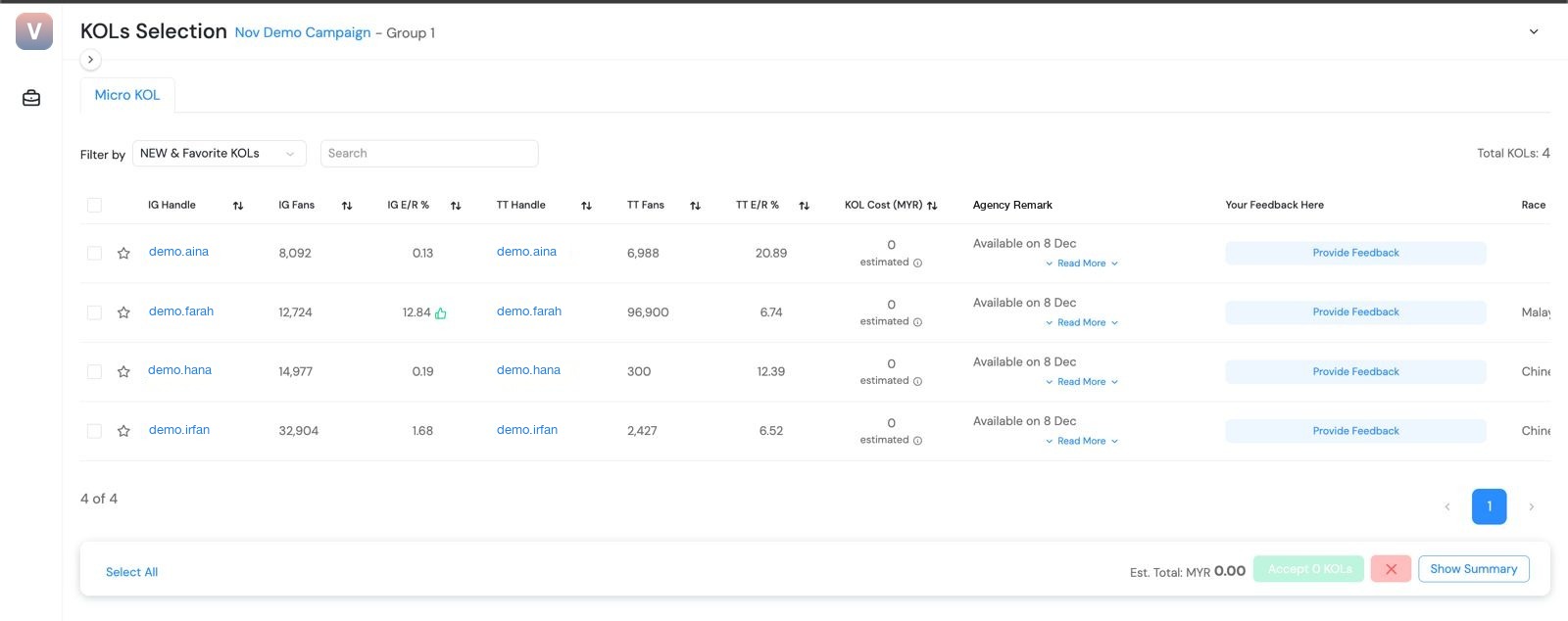
They review and accept the shortlist without a spreadsheet going back and forth.
They comment on drafts in one place, not across email, WhatsApp and calls.
They check progress and results whenever their boss asks, without waiting for you.
This doesn't replace your weekly update. It means the update can focus on insight and next steps, instead of 'here's what's live'.
Set expectations when you onboard each client: who on their side gets a login, who has the final say on drafts, and how quickly you need feedback to keep posting dates. A two-day turnaround agreed upfront saves a lot of awkward follow-ups later.
Shortlists the client can review and accept in their own login.
Two-layer approvals protect you and the client
With many clients, the review process has to be the same every time. A two-layer approval works well:
Layer
Who
What they check
1. Agency review
Account manager or campaign executive
Brief followed, key messages, disclaimers, restricted words, spelling, video quality
2. Client approval
Brand manager, or a second reviewer the client names
Brand fit, product claims, final sign-off
The agency layer means clients only see drafts that are ready, which saves their time and protects your reputation. Recording who approved what, and when, settles any 'we never approved that' conversation quickly. Our guide on how to approve influencer content goes into detail.
Reporting and billing per client
Every client wants their own numbers, in a format they recognise. Use one report template across all brands so your team builds reports quickly, and so results are comparable between campaigns. Our guide to an influencer campaign report has a structure you can copy.
Billing works best when it's also organised per brand:
Track creator fees by brand and campaign, so each client's invoice matches its report.
Agree the deposit or payment terms upfront for creator fees, separate from your agency fee.
Pay creators on a fixed schedule. Late payments hurt your relationships with creators, who work with many agencies.
Keep payment records with the campaign, not in a separate finance folder nobody on the campaign team can see.
Team roles that scale
Small agencies often have everyone doing everything. As the client list grows, clear roles stop work falling through the gaps:
Role
Owns
Typical load
Account manager
Client relationship, briefs, final reports
Several brands
Campaign executive
Creator outreach, drafts, posting dates, links
Several live campaigns
Creator relations
Your creator network, rates, notes on who's reliable
Whole agency
Finance
Creator payments, client invoicing
Whole agency
Add templates for the work that repeats: a brief template, a shortlist format, standard draft feedback, a report template and a creator onboarding message. Templates are what let a new hire be useful in their first week.
Where ViaCRM fits
ViaCRM is built by agencies, for agencies and brands, and it's set up around the problems above:
Priced per brand, so each client is its own space and its own line in your costs.
Separate logins for your team, each client and creators. Clients accept shortlists and comment on drafts in their own login.
Two-layer approval: your project manager first, then the approver (your client), with every approval timestamped.
Unlimited users on every plan, so you don't ration seats between account managers.
Per-client reports with Instagram and TikTok results pulled automatically each week, cost per view and PDF download.
Creator payments from one deposit, paid through Airwallex.
The first campaign for each brand is free, so you can try it with one client before moving the rest. See pricing for plan limits.
Frequently asked questions
How do influencer agencies manage multiple clients?
They use one standard workflow for every client and keep each client completely separate: their own space, approvers, reports and billing. Templates for briefs, feedback and reports let the team handle more brands without more chaos.
Should clients have access to the agency's influencer tool?
Giving each client a login to their own brand saves a lot of status emails. They can review shortlists, comment on drafts and check results themselves, while seeing nothing from other clients.
How should an agency bill influencer campaigns?
Track creator fees per brand and per campaign, agree deposit or payment terms upfront, and keep creator fees separate from the agency fee on invoices. Pay creators on a fixed schedule.
How many clients can one account manager handle?
It depends on campaign size and how much is standardised. Clear roles, templates and client self-service logins all raise the number one person can manage well.
Run your first campaign free
Give every client their own login, approvals and reports in ViaCRM. Your first campaign for each brand is free.
What to put in an influencer campaign report: the metrics that matter, cost per view and engagement formulas, a template, and how to present it to clients.
How to review and approve influencer content: a draft checklist, a two-layer agency and client workflow, turnaround times, and how to give creators feedback.