Influencer campaign management software is the system you run campaigns in after you've chosen your creators: briefs, shortlists, drafts, approvals, posting links, results and payments in one place. To choose one, first decide which part of the job hurts most (finding creators, managing campaigns, paying people or reporting), then test tools against that job with a real campaign.
The word "platform" covers very different products, and that's where most buying mistakes start. This guide explains the categories, gives you a checklist and a set of questions to ask vendors, and shows where ViaCRM fits.
What influencer campaign management software actually does
Think about everything that happens between "the client signed off the budget" and "the final report is sent". That's the job campaign management software is built for:
Briefing creators with objectives, deliverables, dates, do's and don'ts.
Shortlisting creators and getting the brand to agree on them.
Collecting and reviewing drafts, with comments and approvals that leave a record.
Tracking postings: which creator posted what, where and when.
Reporting results in a format the client or your boss will actually read.
Paying creators, and keeping the records your finance team needs.
Without a tool, this lives in WhatsApp chats, email threads, shared drives and a spreadsheet that one person understands. That works for one or two campaigns. It gets painful when you have several clients, dozens of creators and deadlines that overlap. If that sounds familiar, our post on the signs you've outgrown spreadsheets goes deeper.
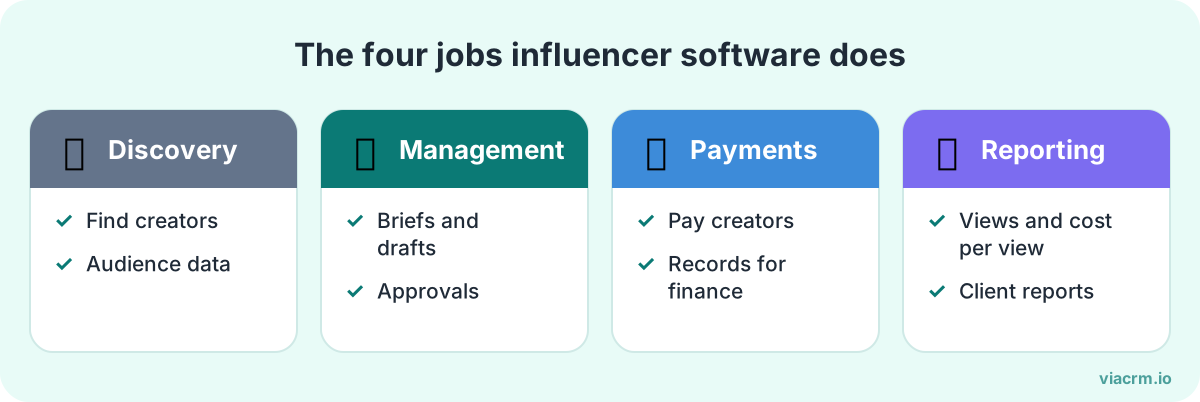
Discovery vs management vs payments vs reporting
Most tools are strong at one or two of these. Know which you need most.
Most tools are strongest at one or two of these jobs. Knowing which is which saves you from paying for features you won't use.
Category
Main job
Good fit if...
Discovery
Search a large database of creators by audience, niche and location
You don't yet know who to work with and need to find new creators often
Campaign management (influencer CRM)
Run briefs, drafts, approvals and postings with the creators you already work with
You have your own creator list and your pain is coordination
Payments
Pay many creators, handle bank details, FX and records
Paying creators takes days of finance admin every campaign
Reporting and analytics
Pull post results and turn them into reports
Your team spends evenings screenshotting posts for reports
Some well-known global tools illustrate the range. Modash is known mainly for creator discovery and search. GRIN is known for creator management for e-commerce brands. Upfluence combines search with campaign management and e-commerce integrations. CreatorIQ is known as an enterprise platform used by large brands and agencies. Each is built around a different starting point, so the right choice depends on what you need.
Two tools with the same monthly price can cost you very different amounts once you add clients, creators and colleagues. Before comparing numbers, work out how each vendor counts.
Pricing model
What you pay for
What it means for an agency
Per seat (per user)
Each person who logs in
Costs rise every time you add a colleague, a client contact or a freelancer. Shared logins to save money ruin the approval record.
Per brand or per client
Each brand you run campaigns for
Easy to pass through to a client retainer. You know your cost before you pitch.
Per creator or per profile
Each creator you track, contact or unlock
Fine for small rosters. Large always-on programmes can get expensive, so ask how 'active' is defined.
Marketplace commission
A percentage of what you pay creators
No fixed fee, but the cost grows with your budgets, and you may not be able to work with creators outside the platform.
For agencies, the question is simple: can I put this cost into a client quote? Per-brand pricing usually maps cleanly to a retainer. Per-seat pricing quietly eats your margin each time you invite a client to approve drafts, which is exactly the habit you want to encourage.
Also check the costs that sit outside the subscription: payment and FX fees per creator, paid add-ons such as messaging, setup or onboarding fees, and whether prices include tax.
What to look for if you're in Malaysia or Southeast Asia
Many well-known tools were built for US and European markets. They can work well here, but check a few things that matter more in this region.
Local currency billing. Paying in RM (or your local currency) avoids FX surprises on your software bill. In Malaysia, ask whether quoted prices include SST and whether the invoice works for your finance team.
Paying local creators. Many Malaysian creators are individuals without a company. Ask how the tool pays them, whether they need to fill in forms, and what each local and foreign payout costs. Our guide on how to pay influencers in Malaysia covers the options.
WhatsApp, not email. Creators here reply on WhatsApp far faster than on email. Check whether the tool works with WhatsApp or expects everyone to live in an inbox.
RED (Xiaohongshu) and Facebook. Malaysian campaigns, especially for Chinese-speaking audiences, often include RED. Ask how results from RED and Facebook are recorded, since many tools only pull Instagram and TikTok automatically.
Languages and sensitivities. Captions often mix English, Malay and Chinese. Brands also care about religious and cultural sensitivities, so a clear review step matters.
Personal data. Creator contacts, IC numbers and bank details are personal data under Malaysia's Personal Data Protection Act 2010 (PDPA). Ask where data is stored, who can access it, and whether the vendor uses your data for anything else.
Mistakes to avoid when choosing
Buying discovery when your problem is coordination. A huge creator database doesn't help if your real pain is chasing drafts.
Forgetting the client. If the client can't log in, you'll still be forwarding screenshots on WhatsApp.
Ignoring finance. Ask your finance team what they need before you choose. Payments are often the biggest time sink.
Choosing on features you'll use once a year. Pick the tool that makes the weekly work easier.
Skipping the team. The people running campaigns every day should trial the tool, not just the person signing the contract.
How to roll out new software to your team and clients in 30 days
New software usually fails because half the team keeps using the old spreadsheet. A short, planned rollout fixes that.
Week 1: set up and choose a pilot. Pick one brand and one upcoming campaign that's typical, not your biggest. Add your creator list, your brief template and your team.
Week 1: decide the rules. Write down what moves into the tool (briefs, drafts, approvals, postings, payments) and what stays where it is. If drafts are still accepted on WhatsApp, people will keep sending them there.
Week 2: run the pilot campaign. Brief creators, collect drafts and run approvals in the new tool. Note what confuses people.
Week 2: bring the client in. Give the client their own login and walk them through approving one draft on a short call. Clients who approve once in the tool usually stay there.
Week 3: close the loop. Record postings, pay creators and send the report from the tool. This is where the time savings become obvious to finance and management.
Week 4: review and expand. Ask the team and client what worked, fix the brief template, then move the next brands across and retire their old spreadsheets.
Keep the first month small. One campaign done properly convinces a team faster than training on every feature.
Where ViaCRM fits
ViaCRM is campaign management software built by agencies, for agencies and brands, by SushiVid Sdn Bhd in Malaysia. It's software, not a marketplace: you bring your own influencers, and your contacts stay yours. Its focus is the work in the middle of a campaign. Creators. Reviews. Money.
Separate logins for agency, client and creators, with unlimited users on every plan.
Briefs with objectives, deliverables, draft and posting dates, restricted keywords, disclaimers and sample content.
Shortlisting from your own list by keyword, niche, audience size, platform and location; clients give feedback and accept the shortlist in their own login.
Two-layer approval: drafts are watched inside ViaCRM, your project manager approves first, then the approver (your client or a higher-up) signs off, and every approval is timestamped. An AI checker flags spelling, profanity, religious sensitivities and banned words.
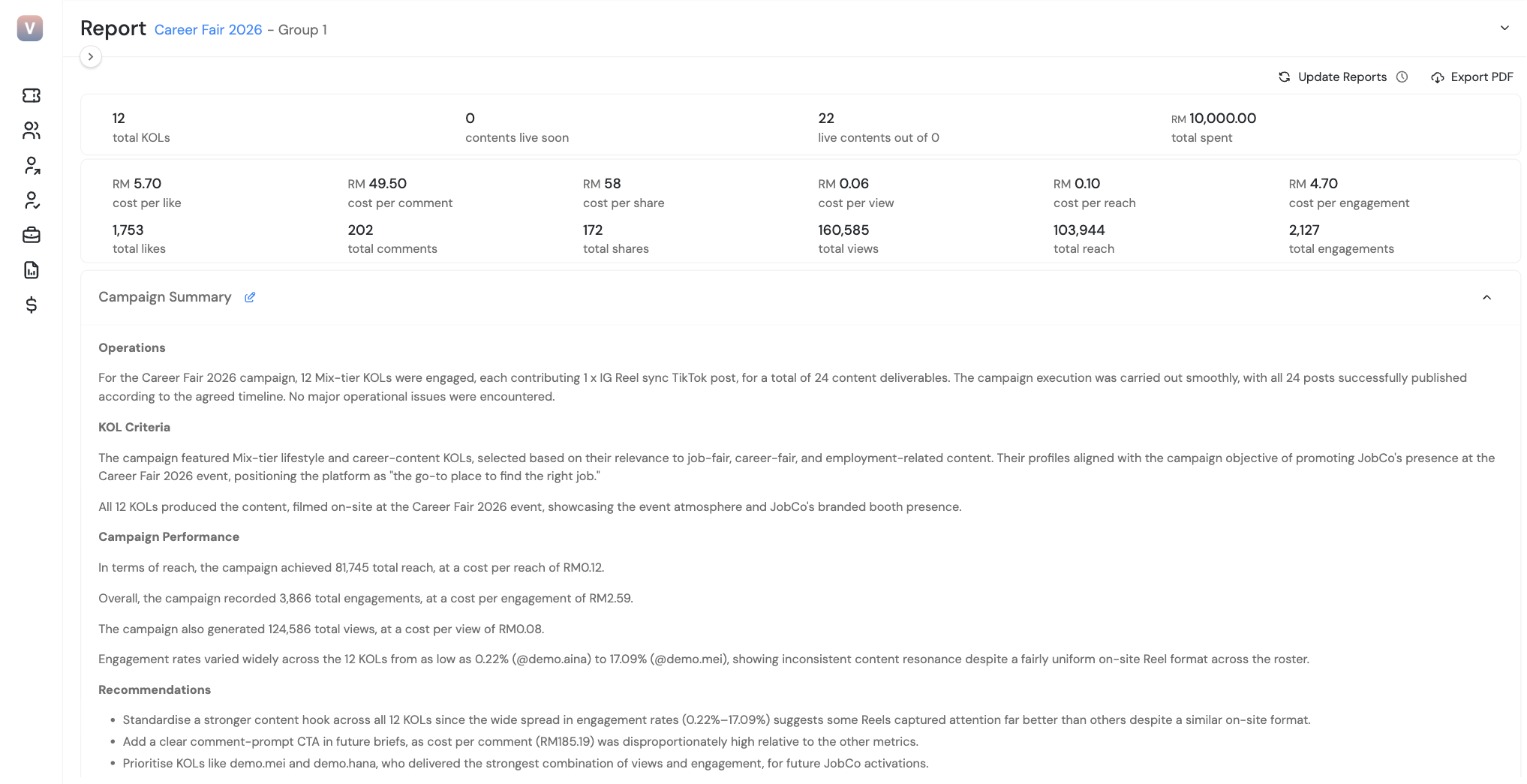
Reports: Instagram and TikTok results pulled automatically and updated weekly; RED, Facebook and X entered manually. Client-ready reports with cost per view, downloadable as PDF.
Personal tracking links for each person, so you can see which posts bring in clicks, not just views.
Payouts: register ViaCRM as one vendor, deposit funds and release payments with a click. ViaCRM pays each influencer through Airwallex, and influencers aren't charged to withdraw.
For integrations with your other systems, and API access on Enterprise, see integrations and API.
Pricing is per brand per month in RM or USD, excluding SST: Starter at RM 389, Growth at RM 1,199, and Enterprise for 150+ active influencers. Agencies that manage a client's own social accounts can use the Social plan at RM 129 per client per month. The first campaign for each brand is free. See pricing or how it works for details.
ViaCRM is built to manage the influencers you already work with, not to be a global discovery database. Malaysian customers can add the SushiVid influencer database for discovery inside ViaCRM; elsewhere, pair it with a discovery tool or your own research.
A campaign summary in ViaCRM.
Frequently asked questions
What is influencer campaign management software?
It's software for running influencer campaigns from brief to payment: shortlisting creators, collecting and approving drafts, tracking posts, reporting results and paying creators. It replaces the mix of spreadsheets, WhatsApp chats and email most teams start with.
What's the difference between an influencer discovery tool and a campaign management tool?
A discovery tool helps you find creators, usually by searching a large database. A campaign management tool helps you run campaigns with creators you already work with: briefs, approvals, postings, reports and payments. Some products do both; most are stronger at one.
How much does influencer campaign management software cost in Malaysia?
It varies widely by vendor and by how pricing is counted: per user, per brand, per campaign or per creator. Ask each vendor for pricing in the currency you budget in. ViaCRM starts at RM 389 per brand per month, excluding SST, and the first campaign for each brand is free.
What is an influencer CRM?
An influencer CRM is a system for managing your relationships and work with creators: contact details, rates, past campaigns, briefs, approvals, postings and payments. Unlike a discovery database, it's built around the creators you already know, and those contacts should stay yours if you change tools.
How much does influencer marketing software cost?
It depends on the pricing model: per user, per brand, per creator, a marketplace commission or an annual enterprise contract. Compare total cost, including payment fees and add-ons. ViaCRM costs RM 389 / USD 89 (Starter) or RM 1,199 / USD 279 (Growth) per brand per month, with custom Enterprise pricing and a Social plan at RM 129 / USD 29 per client per month. Prices exclude SST.
Do agencies and brands need different software?
Not necessarily, but agencies need features brands sometimes don't, such as separate client logins, a client approval step and many brands in one account. Check that the tool fits how many clients you run and who needs to sign off.
Run your first campaign free
Brief, approve, report and pay in one place. Your first campaign for each brand is free.
Seven signs your influencer campaigns have outgrown spreadsheets, what to move first, and a simple checklist to manage influencer campaigns without the chaos.
How influencer agencies manage multiple clients at once: separate workspaces, client logins, two-layer approvals, per-client reporting, billing and team roles.